


With headlines about slowing hiring and growing skills shortages everywhere, it’s easy to think the labour market is falling apart.
The truth?
What we are seeing in 2026 is not collapse. It is recalibration. Demand hasn’t disappeared – it has become more strategic, skills-centric and productivity-driven.
Across Benelux, the UK and Germany the intensity may differ – but the direction is consistent: hiring is becoming more precise.
Europe’s labour market cools – but holds firm
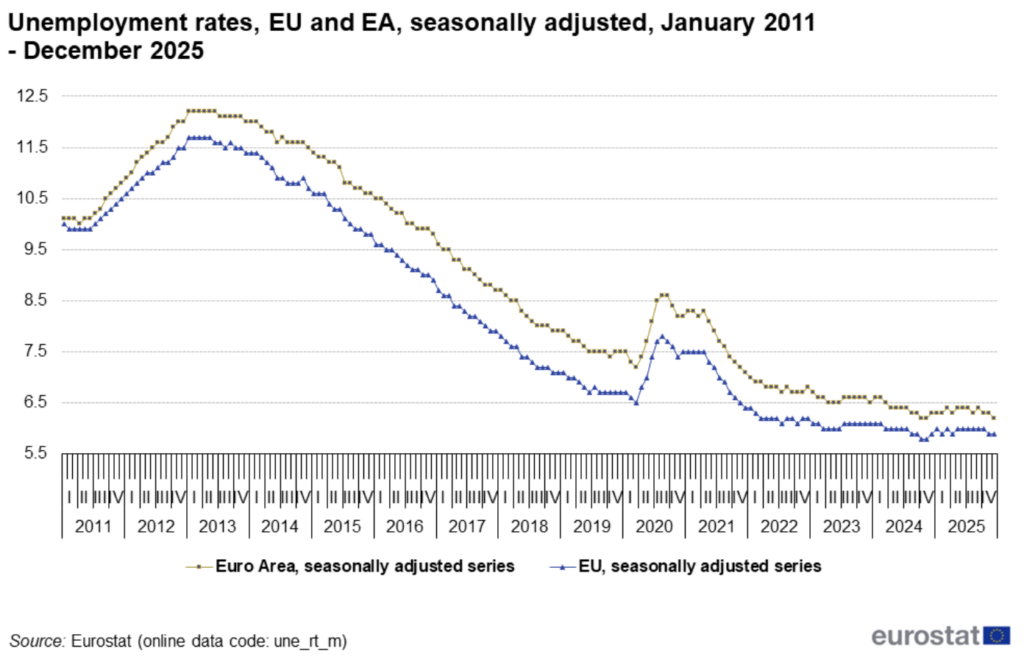
Across Europe, the broader labour market remains stable. The EU unemployment rate stood at approximately 5.9% in late 2025, with youth unemployment around 14.7%. Vacancy growth has moderated, but there is no systemic breakdown.
Benelux remains one of Europe’s tightest labour markets
In the Netherlands, unemployment remained low at around 4% in late 2025, while vacancy rates stayed relatively high at roughly 4.1%, even after cooling from earlier post-pandemic peaks. Belgium shows a similar trend. Unemployment stood at about 6.4%, with companies still facing shortages in sectors such as logistics, engineering and digital roles.
Hiring demand across the region has moderated slightly – but competition for specialised talent remains strong.
Across Europe, the picture looks similar: the market hasn’t weakened, it has narrowed. Demand is no longer expanding rapidly across every sector. Instead, hiring activity is becoming more concentrated around roles where companies see clear economic value.
The UK provides one of the clearest examples of this shift.
The UK: Fewer vacancies, higher expectations
Overall unemployment stands at roughly 5.2%, with youth unemployment between 14-16%.
At the same time, job postings have dropped to around 695,000 – down 16% year-on-year and the lowest level since the post-pandemic boom.
Particularly notable is that graduate roles have fallen below 10,000 for the first time on record.

But context is everything. Vacancies are still above pre-pandemic levels. What has changed is pace, not demand itself.
Meanwhile, competition has intensified. Roughly 2.4 jobseekers now compete per vacancy, particularly in entry-level roles. Yet advertised salaries have increased by nearly 6% in early 2026.
Employers aren’t pulling back. They are simply becoming more selective about where they invest.
As a result, every hiring decision now comes down to three key questions:
- Does this person have the right skills?
- Will they add value as needed?
- What’s the actual business impact?
Germany goes skills-first
According to the Bundesagentur für Arbeit, Germany recorded around 598,000 vacancies in January 2026, down slightly from 619,000 the month before.
What’s changing is not the presence of demand, but its focus. As job growth slows, companies are becoming more selective about who they hire. Stepstone data highlights this shift:
- 87% say they struggle to find candidates with the right capabilities,
- while 77% of companies plan to prioritise skills-based hiring.
As competition for roles grows, employers are focusing more on what candidates can actually do – communication, analytical thinking and adaptability – rather than formal credentials.
Demographics are adding further pressure. For the first time, more people are leaving the German workforce than entering it, while 29% of candidates now say job security is their top priority when choosing a role.
In practice, hiring in Germany is becoming capability-led: in a more selective market, skills – not credentials – define value.
When fewer workers enter than leave
Demographic change is adding pressure. As the baby-boomer generation retires, more people are leaving the workforce than entering it.
In Germany, around 12.9 million workers will reach retirement age by 2036 – nearly 30% of today’s workforce – while the population aged 67+ will grow by about 4 million by the mid-2030s.
The long-standing assumption that new graduates simply replace retirees no longer holds.
As a result, recruitment strategies are evolving. Many organisations are now:
- prioritising adaptability and transferable skills
- investing in reskilling and upskilling pathways
- strengthening internal mobility programmes
These changes reflect deeper shifts in the composition of Germany’s workforce.
Why this matters: A more intentional labour market
Across regions, the data points to a clear shift:
- Hiring volumes have moderated – unevenly, not universally.
- Demand is concentrating in high-impact and specialised roles.
- Skills are overtaking credentials as the key hiring signal.
- Demographic shifts are tightening long-term talent supply.
- Candidates are prioritising stability and long-term security.
The result is a labour market that is becoming more deliberate and capability-driven.
For organisations, success will depend on aligning hiring decisions with measurable business impact. For jobseekers, the message is just as clear: in a more selective market, relevance beats reach.
Sources
- Eurostat – Unemployment Statistics and Labour Market Indicators (EU & Benelux), 2025
https://ec.europa.eu/eurostat - Office for National Statistics – Vacancies and Jobs in the UK: February 2026
https://www.ons.gov.uk/employmentandlabourmarket/
peopleinwork/employment
andemployeetypes/bulletins/jobsandvacanciesintheuk/february2026 - Bundesagentur für Arbeit – Labour Market Statistics Germany, January 2026
https://statistik.arbeitsagentur.de - Stepstone – Skills-based Hiring Trends and Employer Survey Data
https://www.stepstone.de - Statistisches Bundesamt (Destatis) – Population Projection and Demographic Development in Germany
https://www.destatis.de/EN/Themes/Society-Environment/Population/Population-Projection/_node.html